
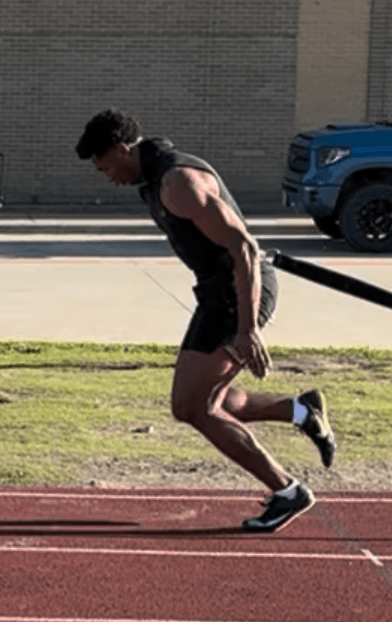
Most athletes aren't slow because they lack effort. They're slow because no one ever taught them how to run.
Top-end velocity is not what your athlete uses.
Football. Basketball. Soccer. Baseball. None of these sports are won at top-end speed.
They are won in the first five to ten yards. They are won by athletes who can drive out of a stance, project their body forward, and produce explosive force in the right positions. The athlete who accelerates better — out of a snap, off a screen, off the dribble, off a base — wins more reps in their sport.
Most speed coaches do not train this well. They run kids through agility ladders, pull them through full 40-yard dashes, and teach top-end sprint mechanics that team sport athletes will rarely use in their sport.
That training builds athletes who look fast in a straight line on a track and look slow in their first three steps on a field, court, or pitch.
Team sport speed has multiple components — acceleration, deceleration, change of direction, conditioning. At Tier1Athlete, we specialize in acceleration mechanics. We coach what most programs teach worst: getting the body to produce explosive force from a standing start, in the positions that actually move the athlete forward.
What's actually limiting your athlete.
Before we can train acceleration mechanics, we have to address what most team sport athletes are working against — their own bodies.
The typical team sport athlete has spent years in athletic stances. Squatting low. Holding position. Driving off the front of the leg. The result is a predictable pattern of imbalances:
Anterior Pelvic Tilt
The pelvis rotated forward, taking the body out of neutral position. Most team sport athletes hold this posture without knowing it.
Quad Dominance
Overdeveloped front of the leg from constant pushing in athletic stances. The quads do too much work; the rest of the chain does too little.
Tight Hamstrings and Tight Hips
Locked from years of athletic positions. Range of motion shrinks. The body cannot get into the positions that produce explosive acceleration.
Underdeveloped Posterior Chain
The glutes, hamstrings, and low back that should be powering acceleration. Undertrained because the sport rarely demands them.
These imbalances are the ceiling on how fast your athlete can ever be. You cannot train explosive acceleration into a body that cannot get into the right positions to produce it.
The first job of real speed coaching is fixing this baseline. Then we train the mechanics.
What Gets Coached
Hip Mobility & Pelvic Position
We restore range of motion in hips and ankles, and work the pelvis back toward neutral. Without this, no amount of sprint training will produce real change.
Posterior Chain Strength
Glutes, hamstrings, low back — the muscles that drive acceleration. We strengthen what's been underdeveloped so the body can finally produce the force it should be producing.
Acceleration Mechanics
What it actually looks like to drive forward in the first ten yards. Body angle. Shin angle. Foot strike. Force application. Coached slowly, corrected rep by rep.
Horizontal Hip Projection
The single most misunderstood concept in team sport speed. Most athletes try to stand up too fast. We teach what it feels like to project the hips horizontally out of a stance — the difference between explosive acceleration and a slow start.
Sprint Posture
Tall, stacked posture once the athlete is upright. Most team sport athletes have never felt what good sprint posture is because their sport doesn't ask for it. We teach it.
Unlearning Bad Habits
Most athletes have been taught wrong. Coaching errors get passed down through programs that don't understand sprint mechanics. Part of every session is unwinding what's been incorrectly drilled in for years.
How a session looks
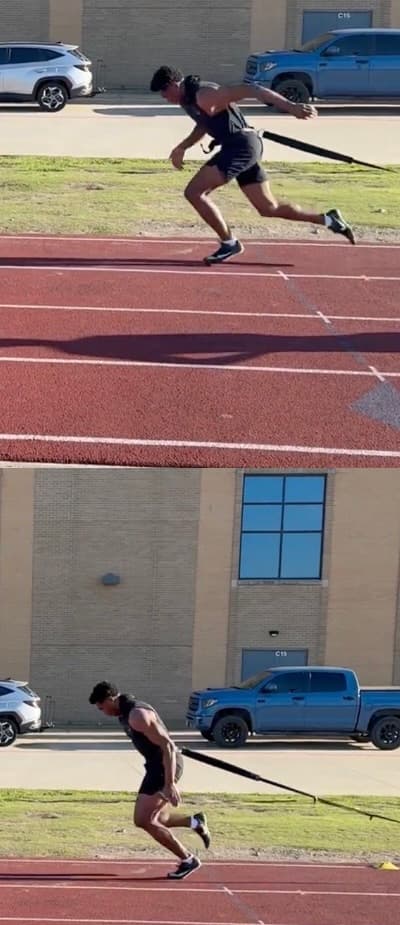
Same athlete · Same angle · 8 weeks apart
Same athlete. Same camera angle. What changed is the timing.
Before
The support leg is too far in front of the hip. The back thigh is too far behind it. The arms aren't in sync with the legs, and the torso is collapsed forward. He's working hard — but the limbs aren't organized.
After
We timed the limbs. The support leg is directly underneath the hip. The back thigh is vertically in line with the hip, even with the support leg. Arms in sync. This is what coached acceleration looks like.
Inside one session
Movement Prep
We work on the timing of the limbs when the athlete is fresh, not fatigued. Before ending the warm-up, we use drills that focus on thigh reversal, switching, and synchronizing the arms with the legs.
Acceleration Mechanics
Drive phase work, resisted starts, posture and limb-timing drills. Track athletes have 30 yards to accelerate. Football, basketball, and soccer players get 5. Acceleration sets up max velocity — and team sport athletes need to reach it sooner, in fewer steps. Coached slowly, corrected rep by rep.
Max Velocity
Fly-ins, upright sprint mechanics, top-end speed. Once acceleration is timed, we train the athlete to hold form as the body rises out of the drive phase.
Recovery
Mobility, breathwork, cooldown. Recovery is part of the work, not what happens after it — and it's where adaptation actually starts.
What's Included
Common Questions
My athlete is in season. Can they still train with you without overtraining?+
My athlete plays football, basketball, or soccer. Do you specialize in their sport?+
Do you train deceleration and change of direction?+
How long before we see results?+
Do you train athletes who are already fast?+
What if my athlete's school coach doesn't want them training elsewhere?+
Enrollment Is Capped.
When the season fills, it fills. That's how every athlete gets coached directly.
Register NowBy registering you agree to our Terms & Conditions.